Step 1: Make the Sweet Levain (Night Before) In a clean jar, mix your mother starter with the flour, water, and sugar. Give it a good stir, and allow it to rest at room temperature (optimally 73-75 degrees F). I like to mark the volume in my jar with a rubber band so it's easy to asses the rise the next morning. When the sweet levain has doubled in size, it's time to mix your cinnamon roll dough.
Step 2: Make the Tangzhong Before you get started on mixing your dough, you'll make your tangzhong. Whisk milk and flour together in a small saucepan.
Cook the tangzhong over medium/low heat, stirring constantly, until it thickens into a paste that is similar to pudding (about 2–3 minutes). For precision, use your digital thermometer and heat to 148-155 F. Do not overheat, or your mixture will be too thick.
Scrape into a bowl immediately to prevent further cooking, cover, and let cool to room temperature before adding to your dough.
Prepare your dough while tangzhong cools.
Step 3: Mix the Dough Baker's Schedule: 8:30 AM- Day 1
In a stand mixer fitted with a dough hook or large mixing bowl, add all of the tangzhong, whole milk, sweet levain, eggs, sugar, and vanilla. Whisk ingredients together quickly, it's okay if it's lumpy.
Add your flour and salt into your wet ingredients. Mix on low until a shaggy dough forms, about 2-3 minutes. Scrape down bowl if needed. If using your hands, knead until you work dough together. This is a higher hydration dough, so be aware it will be sticky.
Once the dough has come together add softened butter, a tablespoon at a time mixing each tablespoon in until adding the next. Use a dough scraper to scrape the edges of the bowl to make sure everything is getting mixed in.
Continue mixing on medium-low (speed 2–3) for 8–10 minutes, until dough is smooth, elastic, and tacky but not sticky. If mixing by hand, knead dough until butter has fully incorporated and dough is smooth and tacky.
Mixing Notes: If kneading in a mixer or if dough is very wet when mixing by hand, add an additional 25 grams (3 Tablespoons) of flour and mix into dough. Make sure to work flour in completely and assess if you need more flour.
Do not add more than 50 grams of flour at this stage, or you will lose the high hydration of the dough and end up with a dense cinnamon roll. If using a stand mixer, dough can become more warm and sticky and I have found kneading dough with my hand (perform a set of stretch and folds) for a minute after mixing in my stand mixer really helps bring the dough together.
Step 4: Bulk Fermentation Spray a clean bowl with oil. Shape the dough into a smooth ball and place it in the bowl. Cover with plastic wrap.
If you used a stand mixer, perform one set of stretch and folds after 30 minutes to strengthen your dough. If you mixed dough by hand, perform 3 sets of stretch and folds at 30 minute intervals at the beginning of bulk fermentation. After stretch and folds are completed, cover dough and allow to continue proofing.
To complete a set of stretch and folds simply lift the dough at the edge, and fold it into the center. Repeat this step until you've formed a ball with your dough.
Let dough rise at 75–80°F until doubled in size, this takes about 6-7 hours. If your house is very cold, you can put dough in the oven with the light on for a warmer atmosphere. This proofing time is a general guide, this process may take longer the key is to assess when the dough has nearly doubled that's when it's ready.
Overnight Fermentation: Once dough has finished rising, you can cover and transfer to the refrigerator overnight for a longer ferment or you can simply skip straight to shaping your rolls.
Step 5: Prepare the Pecan Topping If you're using whole pecan halves, chop them to the pieces you desire for the topping and pour in the bottom of a greased 9x13 baking pan.
In a medium-sized pot melt the butter, brown sugar, maple syrup, cream, and salt over medium/low heat. Whisk constantly for about 4-5 minutes until everything has melted together, then remove from heat.
Pour the caramel over the top of the pecans in the baking sheet.
Step 6: Shape the Cinnamon Buns Note: If refrigerating dough overnight, remove from refrigerator at this time and allow to rest 30 minutes at room temperature to take off the chill.
Before you shape your rolls, make sure your butter is room temperature for your cinnamon sugar paste.
In a small mixing bowl, combine the brown sugar, cinnamon, flour, salt and butter together to form a paste. Set aside for later.
On a lightly floured surface, roll dough into a 20x10-inch rectangle with the 20-inch edges being the bottom and top. Use a tape measure or ruler if needed to measure. Trim any excess edges if needed to get a clean line.
Spread top of dough with the cinnamon sugar paste you prepared earlier, making sure it's evenly spread all over the dough to meet the edges leaving a 1/2 inch border at the top.
Mark the bottom edge (20-in edge) every 1 and 1/4 inches to create 12 strips. Use a knife or pizza wheel to cut 12 clean long strips.
Starting at the bottom of each strip, roll up each strip to form your cinnamon bun.
Place rolls into the pan prepared with pecan topping in 3 rows of 4 to proof. Cover with plastic.
Optional Shape Ahead Instructions: As long as you made your dough the same day, you can shape your rolls and place in the pan with the pecan filling and cover with plastic then refrigerate overnight to save yourself an additional step the next morning. Do not allow rolls to proof at this point and place directly into refrigerator covered with plastic. Continue with final proof the next morning. This may take longer as your dough will be cold. Do not do this if you have already refrigerated dough overnight, as you will run the risk of over proofing you rolls.
Step 7: Final Proof Cover rolls with plastic wrap and let rise at warm room temp (74–78°F) for 2 hours, or until noticeably puffy and nearly doubled as pictured.
Step 8: Bake and Invert Rolls Preheat oven to 350°F (175°C).
Bake rolls for 40-45 minutes, or until tops are golden and firm. Because these rolls are thicker, it's important to make sure the center portion of the roll has reached the proper temperature to avoid an underbaked roll. Internal temperature of center of roll should read 200–205°F.
If rolls are browning too quickly, tent loosely with foil during the last 10–15 minutes.
Remove the rolls from the oven, and allow to cool roughly ten minutes. While the rolls cool, line a serving platter or a baking sheet with parchment (make sure it's larger than your 9x13 pan). Don't allow the rolls to cool too long or they'll stick to the pan.
After the rolls cool slightly, place the parchment lined tray over the 9x13 pan and hold the pans together using hot pads while you flip (invert) the pan upside down to dump the rolls out on to the parchment lined tray.
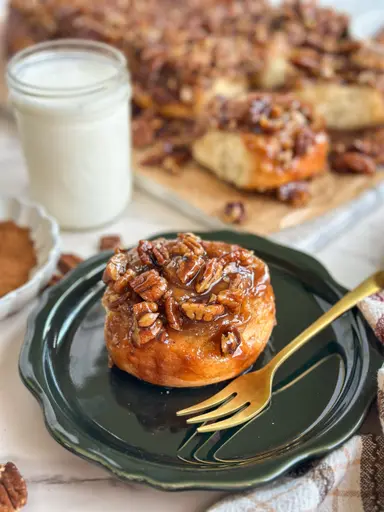
Allow the rolls to cool another 10 minutes and serve warm!